ATR-42
ATR-42-200 (PROTOTYPE)
ATR-42-300 (FROM 1985)
ATR-42-300 QC (FROM 1986)
ATR-42-320 (FROM 1987)
ATR-42-400 (FROM 1995)
ATR-42-500 (FROM 1996)
ATR-42-600 (FROM 2007)
ATR-42-600 S
INTRODUCTION

Above, most
ATR-42-300 units are still operating, transporting passengers and/or cargo on
intercity and interstate trips, mainly by regional airlines and cargo transport
companies. Below, the ATR-42 of the German airline Lufthansa Regional, which
was once one of the largest ATR-42 operators in the world.

The ATR-42
is a pressurized, medium-sized, twin-engine commercial aircraft with turboprop
propulsion, high wings, and the capacity to carry 46 passengers (medium-density
configuration) or 50 passengers (high-density configuration) on intercity and
interstate trips (domestic routes). It was created, developed, and manufactured
on a large scale in France and Italy starting in the 1980s by ATR - Avions de
Transport Régional, the world's largest manufacturer of turboprops for regional
passenger transport.
The ATR-42
is a completely original project by ATR, a company formed in the 1980s by the
French manufacturer Aerospatiale (currently known as Airbus) and the Italian
manufacturer Aeritalia (later known as Alenia Aeronautica). The ATR-42 regional
turboprop is the result of joint research and development by major
manufacturers from several European countries, mainly France and Italy;
however, the turboprop engines are manufactured in Canada by the American
multinational Pratt & Whitney, through its subsidiary Pratt & Whitney
Canada.
Currently,
the French manufacturer ATR - Avions de Transport Régional is owned by Airbus
Group (also known as Airbus SE, formerly EADS - European Aeronautic Defense and
Space Company) and Leonardo SpA (also known as Leonardo Group, formerly Alenia
Aeronautica).
Currently,
the ATR-42 has no direct competitor in the new regional aircraft market. The
models that come closest to its capacity are the Brazilian regional jets
Embraer ERJ-145 and Embraer ERJ-140, both twin-engines, manufactured until 2020
in Brazil. In recent decades, its main competitor in the global aviation market
was the Bombardier Q-300 / de Havilland Dash 8-300 twin-engine regional
turboprop, manufactured by the Canadian company Bombardier Aerospace, which, in
practice, can still be considered a competitor in the regional aviation market,
although it is no longer in series production.
ATR

ATR –
Avions de Transport Régional, in French, is a major French and Italian
manufacturer of turboprop aircraft for regional passenger and cargo transport.
It was founded in 1981 by the then French aircraft and helicopter manufacturer
Aerospatiale (pronounced Aerrospachál in French) and the then Italian aircraft
manufacturer Aeritalia (later known as Alenia and currently as Leonardo, one of
Italy's largest high-tech conglomerates).
Also known
as ATR – Aerei di Trasporto Regionale, its name in Italian, it is the largest
manufacturer of commercial turboprop aircraft for regional passenger and cargo
transport in the world, with more than 2,300 aircraft manufactured since the
1980s, basically ATR-42 and ATR-72 models. It had a gross revenue of over US$
1.8 billion in 2017, with more than 1,300 employees in the same year, mainly in
Italy and France, where the aircraft assembly lines are concentrated.
In the
early 2000s, Aerospatiale / Matra of France, Daimler / DASA / Dornier of
Germany, and CASA of Spain formed the EADS aerospace consortium, which later in
2014, after various mergers and acquisitions, became the Airbus Group. This
corporation owns the traditional commercial passenger jet manufacturer Airbus,
the ARIANE satellite launch vehicle, and helicopters such as the H-120 / EC-120
Colibri, H-130 / EC-130, and H-135 / EC-135, among others produced by Airbus
Helicopters / Eurocopter (all with Fenestron tail rotors), as well as the
Helibras AS-350 Esquilo / H-125 manufactured in Brazil by Helibras, among other
models.
Airbus
Group is a partner with the Italian company Leonardo SpA (formerly known as
Finmeccanica) in the company ATR - Avions de Transport Régional, which carries
out the final assembly of the ATR-42 and ATR-72 in Toulouse, France.
MAIN FEATURES

Above, a
simplified illustration of one of the seat configurations available for the
ATR-42-600, with 50 passengers in high density, from the charter company Air
Charter, which also serves Brazilian clients. Below, the beautiful design of
the ATR-42 passenger cabin, with rows of four seats separated by a central
aisle.

The
versatile ATR-42 is a pressurized, medium-sized, twin-engine commercial
aircraft with turboprop propulsion, high straight wings, and retractable
tricycle landing gear. It features conventional construction in aluminum and
metal alloys combined with smaller parts in composite material. It has the
capacity to transport 46 passengers in a medium-density configuration or 50
passengers in a high-density configuration on domestic routes.
It is the
result of joint research and development between major European manufacturers,
but its turboprop engines are manufactured in Canada by Pratt & Whitney. It
is essentially an aircraft model dedicated to regional passenger and cargo
transport on short and medium routes, the vast majority of which are intercity
and interstate, although international transport is also possible in some
cases.
Although
some military versions were also created and sold, since its origin, the ATR-42
project has been primarily focused on the civil regional air transport market.
Among its main necessary characteristics are structural robustness and comfort
to meet the needs of airlines for a type of equipment that is economically
viable and safe for operations in small and medium-sized cities, which generally
have less sophisticated infrastructure than large international airports.
It is a
modern aircraft with a variety of parts built in composite material, although
the main parts, such as wings and fuselage, are made of aluminum and alloys.
The fuselage and tail are manufactured in Italy by Alenia / Leonardo, and the
wings are manufactured in France by Stelia Aerospace (formerly Sogerma /
Aerolia), a subsidiary of Airbus Group. Final assembly is performed by ATR in
Toulouse, France, which also houses a large pilot training center for ATR-42
and ATR-72 turboprops maintained by Airbus Group.
The ATR-42
is widely used in Brazil and many other countries, especially by regional
airlines. Generally, regional aircraft must have simplified operations because regional
airports do not have the same level of sophistication as large metropolitan
airports. Therefore, the ATR-42 was designed with its fuselage as close to the
ground as possible to facilitate passenger boarding via the rear door and
cargo/baggage loading via the front cargo door.
The ATR-72
(larger) and the ATR-42 (smaller) are part of the ATR family, which are among
the best-selling commercial turboprop families in the world. Technically, in
terms of propulsion and other systems, the ATR-42 is on par with the Brazilian
regional turboprop Embraer EMB-120 Brasilia, although the Brazilian model has a
lower passenger capacity.
CREATION AND DEVELOPMENT

Above, an
image of an ATR-42-500 from Cabo Verde Airlines on a typical regional airport
apron, highlighting its vocation for passenger transport with the fuselage
close to the ground. This version is one of the most modern, featuring a
six-blade propeller set with lower noise and vibration levels. Below, the
ATR-42 model from the Brazilian airline MAP, flying over the Amazon region. It
was chosen for its operational flexibility on runways of limited length, common
in that region.

The ATR
family aircraft were created in the early 1980s based on the perception of
designers and investors from Aerospatiale and Aeritalia regarding the growing
regional air transport market. They believed there was room for another
competitor, the ATR-42, with a 46-seat capacity. Thus, the companies joined to
form ATR – Avions de Transport Régional, headquartered in France, with a 50/50
partnership.
The
then-new ATR-42 was meant to be the result of merging two similar projects: the
Aerospatiale AS35 and the Aeritalia AIT230. It aimed to offer technical and
economic advantages over regional turboprops of the time. For example, it was
intended to be at least 50% more economical than the Dutch Fokker F-27.
During the
1980s, several medium-sized twin-engine turboprops were under development or in
production, including the Fokker F-50, the Embraer EMB-120 Brasilia, the Saab
340, the British Aerospace ATP, and the de Havilland DHC-8-300. ATR was born
with the combined experience of its parent companies. The first development
flight of the ATR-42 occurred in 1984, entering service in 1985 with the French
regional airline Air Littoral (now defunct).
The ATR
Project cost approximately US$ 250 million (equivalent to roughly US$ 750
million today). Financial break-even was reached after the 200 units were
manufactured. Initially, the first series units were named ATR-42-300, followed
by the ATR-42-320 with more powerful engines for "hot and high"
operations. The aircraft feature a large front door for baggage/cargo and a
rear door for passengers.
The first
production model, the ATR-42-300, was powered by the Pratt & Whitney PW120
(1,800 shp each). This engine family (PW100) powers various aircraft, including
the Bombardier Q-400 and the CASA C-295. Their high-wing placement protects
them from Foreign Object Damage (FOD) on unrefined runways. The PW100 series is
a massive success, with over 8,000 units manufactured and 130 million flight
hours accumulated.
By the
1980s, ATR already included a surprising amount of composite materials in the
wings and tail, though the main fuselage remains aluminum. The aircraft uses
pneumatic "de-icing boots" on the leading edges. The hydraulic system
is dual: one for landing gear and main brakes, and another for flaps, spoilers,
emergency brakes, and nose-wheel steering.
Notably,
the ATR-42 generally does not have an APU (Auxiliary Power Unit). Instead, it
uses a "propeller brake" on one engine (usually engine #2). This
allows the engine to run and provide electricity and air conditioning on the
ground while the propeller remains stationary, ensuring safety for ground crews
and passengers.
ATR-42 VERSIONS

Just above, the ATR-42-500 from the French airline Air
France / HOP!, one of the most modern versions of the ATR family, with a
six-blade propeller set, featuring lower noise and vibration levels than in
previous versions. Just below, the previous version ATR-42-300. The main
difference between these two versions of the ATR-42 is the more powerful engine
combined with the six-blade propellers of the more modern version.

Generally speaking, ATR-42 aircraft are pressurized
twin-engine turboprops with high, straight wings, featuring turboprop engines
from the Canadian brand Pratt & Whitney, with conventional construction in
aluminum and metal alloys and intercity and interstate range, although they are
also used by several airlines for international flights and, in some cases,
even for flights over seas, deserts, and forests, as the more modern models
possess ETOPS 120-minute certification.
The ATR-42-300 model, for example, is the original
factory model, from which all more modern versions of the ATR-42 were created
and developed, all with final assembly carried out in France, using parts,
pieces, and components manufactured in France and Italy. The most recent and
modern version of the ATR-42 is the ATR-42-600, powered by Pratt & Whitney
PW127M turboprop engines, which are more powerful and robust than the engines
of previous versions, with more power reserve available for takeoff on hot
days.
All versions of the ATR-42 have a circular fuselage
section, with 2.8 meters of total fuselage width, excluding the landing gear
from this measurement, providing 2.6 meters of usable width for four seats per
row, separated by a central aisle, at the same level as the completely flat
floor. The passenger cabin seats have 43 centimeters of usable width in single
class, for a total of 46 passenger seats in medium density, or 50 passenger
seats in high density, with about 75 centimeters between rows of seats. It is
not much, but it is enough for one or two hours of flight.
The vast majority of versions of the ATR-42 regional
turboprops were manufactured with a rear left door for passenger boarding and a
wide forward left door for easier introduction of baggage and cargo. The models
that do not have an APU – Auxiliary Power Unit, which are also the vast
majority, are slightly lighter and have a rear baggage compartment combined with
the forward baggage compartment which, together, facilitate the control of the
aircraft's center of gravity, which, in turn, improves the maneuverability of
the plane during landings and takeoffs, as baggage and air cargo are thus
better distributed in the fuselage. For passenger comfort, one of the engines
remains on indefinitely while on the ground to power the air conditioning unit.
All ATR-42s are modern, efficient, and versatile
aircraft. They operate well on runways of limited length, with few weight
restrictions, even on hot days, especially the more powerful and more recent
versions. In medium and low-density seat configurations, they can be considered
reasonably comfortable, considering current regional aviation standards, with
enough legroom for passengers up to 1.75 meters tall.
ATR-42-300

The ATR-42-300 is a medium-sized pressurized
twin-engine aircraft with turboprop propulsion, high and straight wings,
featuring conventional construction in aluminum and metal alloys and with the
capacity to transport 46 passengers, in medium density, or 50 passengers, in
high density, on intercity and interstate trips (domestic routes), created,
developed, and manufactured on a large scale in France and Italy starting in
the 1980s by ATR - Avions de Transport Régional, the largest manufacturer of
turboprops for regional passenger transport in the world.
It is the original model from which all other versions
were created. Compared to the larger ATR-72 model, it has 4.5 meters less
fuselage length and smaller wings. The first operator of the ATR-42-300 turboprop
plane was the French regional airline Air Littoral, starting in 1985, consuming
half the fuel of a similar aircraft of the time, the Fokker F-27.
It is powered by the Pratt & Whitney PW120
turboprop, with 1,800 shp of power in each engine, totaling 3,600 shp, with
four-blade Hamilton Standard propellers, with a cruising speed of about 450
km/h, a service ceiling of about 7,000 meters, and a range of about 800
kilometers, with the cabin full of passengers.
A sub-version of the ATR-42-300 was manufactured, the
ATR-42-300 QC, also known as the ATR-42-300 Quick Change, with the possibility
of being quickly converted into a cargo transport aircraft, with the removal of
its passenger seats in just one hour.
ATR-42-320

The ATR-42-320 is a medium-sized pressurized
twin-engine aircraft with turboprop propulsion, high and straight wings,
featuring conventional construction in aluminum and metal alloys and with the
capacity to transport 46 passengers, in medium density, or 50 passengers, in
high density, on intercity and interstate trips (domestic routes), created,
developed, and manufactured on a large scale in France and Italy starting in
the 1980s by ATR - Avions de Transport Régional, which used the original
ATR-42-300 model as the basis for its creation and development.
It is powered by two Pratt & Whitney PW121
turboprop engines, with 1,900 shp of power available at takeoff in each engine,
with four-blade Hamilton Standard propellers, with a cruising speed of about
480 km/h and a service ceiling of about 7,000 meters, with a range of about 850
kilometers, in this case taking off with the cabin full of passengers.
It was designed, developed, and manufactured by ATR –
Avions de Transport Régional to meet requests from regional airlines for
equipment with better performance at hot, humid, and high airports, as it is
more powerful than its predecessor, the ATR-42-300.
ATR-42-400

The ATR-42-400 is a medium-sized pressurized
twin-engine aircraft with turboprop propulsion, high and straight wings,
featuring conventional construction in aluminum and metal alloys and with the
capacity to transport 46 passengers, in medium density, or 50 passengers, in
high density, on intercity and interstate trips (domestic routes), created,
developed, and manufactured on a large scale in France and Italy starting in
the 1990s by ATR - Avions de Transport Régional, which used the ATR-42-320 as
the basis for its creation and development.
It is an improved ATR-42 model compared to previous
versions. Only 5 units were manufactured, 3 of which were military units for
the Italian Armed Forces and 2 civil units for the airline CSA Airlines, later
resold to the airline Conviasa.
Among the differences compared to its predecessor, the
ATR-42-320, are the six-blade propellers, with lower noise levels compared to
the previous model, driven by the Pratt & Whitney PW121 turboprop engine,
with power increased to 2,000 shp at takeoff, with a cruising speed of about
480 km/h, a service ceiling of about 7,500 meters, a range improved to 1,500
kilometers, and a maximum takeoff weight increased to 18,200 kg, but
remembering that it is not always possible to combine maximum passenger and
cargo capacity with range, as it depends on several factors.
ATR-42-500

The ATR-42-500 is a medium-sized pressurized
twin-engine aircraft with turboprop propulsion, high and straight wings,
featuring conventional construction in aluminum and metal alloys and with the
capacity to transport 46 passengers, in medium density, or 50 passengers, in
high density, on intercity and interstate trips (domestic routes), created,
developed, and manufactured on a large scale in France and Italy starting in
the 1990s by ATR - Avions de Transport Régional, which used the ATR-42-320 as
the basis for its creation and development, but with several significant
improvements.
It is an improved ATR-42 model compared to previous
versions, manufactured on a large scale starting in 1995 to meet requests from
regional airlines in general, powered by two Pratt & Whitney PW127E turboprop
engines, with 2,160 shp (twin-engine takeoff) or 2,400 shp (single-engine
takeoff) of power available at takeoff in each engine, with six-blade Hamilton
Standard 568F propellers made of composite material, with a cruising speed of
about 500 km/h and a service ceiling of about 7,500 meters, with a range of
about 1,300 kilometers, in this case taking off with the cabin full of
passengers, on hot days.
Noise levels on board the ATR-42-500 were reduced
thanks to the use of the Hamilton Standard six-blade propeller in composite
material. Other aspects were also improved, such as, for example, the increase
in maximum takeoff weight to 18,600 kg, the range increased to about 1,300
kilometers, with a full cabin, and ETOPS 120-minute certification, which made
it possible to fly over seas, deserts, and forests.
The first operator of the ATR-42-500 version was the
Italian airline Air Dolomiti, in 1995.
ATR-42-600

The modern ATR-42-600 is a medium-sized pressurized
twin-engine aircraft with turboprop propulsion, high and straight wings,
featuring conventional construction in aluminum and metal alloys and with the
capacity to transport 46 passengers, in medium density, or 50 passengers, in
high density, on intercity and interstate trips (domestic routes), created and
developed in France and Italy starting in the 2000s by ATR - Avions de
Transport Régional, which used the ATR-42-500 as the basis for its creation and
development, but with some significant improvements.
Also known as the ATR-42-500 Model 5948, it is an
improved and modernized ATR-42 model compared to previous versions,
manufactured on a large scale starting in 2010 to meet requests from regional
airlines in general, powered by two Pratt & Whitney PW127M turboprop
engines, with 2,160 shp (twin-engine takeoff) or 2,400 shp (single-engine
takeoff) of power available at takeoff in each engine, with six-blade Hamilton
Standard 568F propellers made of composite material, with a cruising speed of
about 500 km/h and a service ceiling of about 7,500 meters, with a range of
about 1,300 kilometers, in this case taking off with the cabin full of
passengers, on hot days.
It is the ATR-42 model that has received the most
improvements and modernizations, with low internal noise levels; with LED
lighting in the passenger cabin; with the definitive and broad introduction of
the EFIS – Electronic Flight Instrument System concept in its cockpit; and with
lighter seats, made of composite material; among other modernizations and
improvements. Its maximum takeoff weight was maintained at 18,600 kg, relative
to the previous ATR-42-500 version, with maximum available power also
maintained.
The modern ATR-42-600 is fully within the glass
cockpit concept, with five LCD - Liquid Crystal Display screens, with avionics
provided by the French manufacturer Thales, certified for ILS Cat III
instrument approaches, and certified for RNP satellite precision navigation,
among other modernizations.
ATR-42-500 S

The modern ATR-42-600 S is a medium-sized pressurized
high-performance twin-engine aircraft with turboprop propulsion, high and
straight wings, featuring conventional construction in aluminum and metal
alloys and with the capacity to transport 46 passengers, in medium density, and
50 passengers, in high density, on intercity and interstate trips (domestic
routes), created and developed in France and Italy starting in the 2010s by ATR
– Avions de Transport Régional, which used the ATR-42-600 as the basis for its
creation and development, but with some improvements.
Also known as the ATR-42-600 STOL, it was created to
serve airlines that operate or intend to operate at airports in developed and
developing cities, but with runways of limited length. According to the French
and Italian manufacturer ATR, there are about 1,000 airports in small and
medium-sized cities on the planet, both developed and developing, therefore
with demand and flow of regular air transport passengers, including cities with
a tourist profile, with paved runways of about 1,000 meters, which would justify
the use of an aircraft with the profile of the ATR-42-600 STOL.
According to the manufacturer, it features a variety
of small improvements that enable takeoff with 42 passengers on board, with
light baggage, even on hot days, from a 1,000 meter runway, with enough fuel to
travel up to 500 kilometers, including improved brakes, more capable of
braking; improved flaps and improved rudders; spoilers over the wings to
improve braking on the ground after touchdown during landing; lighter seats,
therefore improving takeoff capacity; among other improvements.
It is powered by two Pratt & Whitney PW127L
turboprop engines, with 2,400 shp of power (twin-engine takeoff) in each
engine, or 2,750 shp of power (single-engine takeoff), with six-blade Hamilton
Standard propellers made of composite material, with a cruising speed of about
530 km/h and a service ceiling of about 7,500 meters, with a range of about
1,260 kilometers, in this case taking off with the cabin full of passengers.
In 2024, the European manufacturer ATR decided to
temporarily suspend the development of the ATR 42-600S version until the global
aviation market shows sufficient demand for this model once again.
MARKET
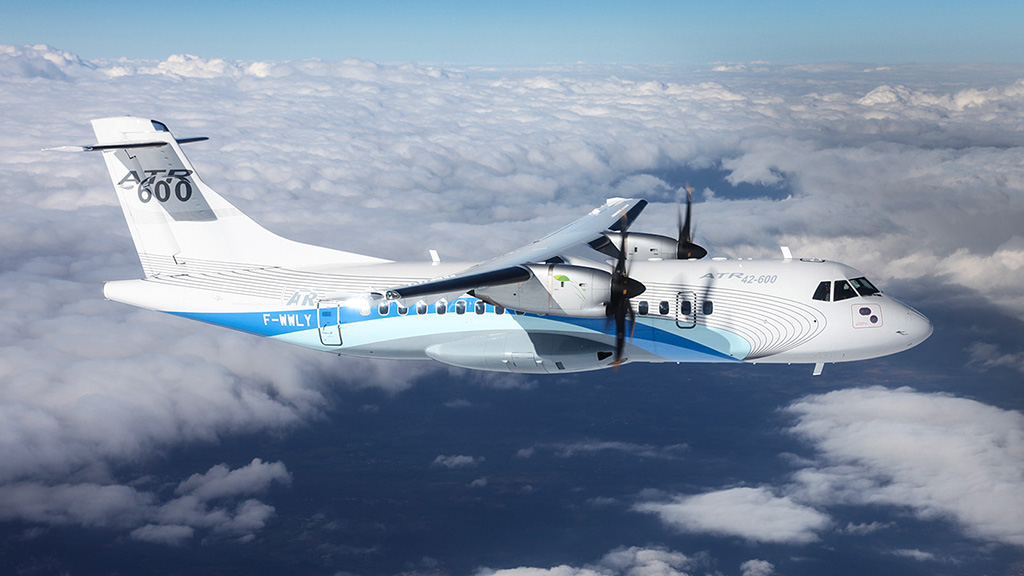
Just above, an image of an ATR-42-600 in full flight,
with a beautiful blue and white background. This version of the ATR-42 is the
most modern in the ATR family, with a six-blade propeller set, with lower noise
and vibration levels than in previous versions. Just below, an image of the
ultra-modern cockpit of the ATR-42-600, the most modern version of the ATR-42,
with most of the avionics manufactured by Thales, of France.
.jpg)
The ATR-42 was specially designed to meet requests
from regional airlines for a type of equipment adapted for operations on
runways with less than 1,500 meters in length, with more complicated takeoff
and approach procedures. Practically all modern turboprop aircraft have more
static power (static thrust) than jet aircraft of the same size and maximum
takeoff weight.
However, from an economic point of view, on routes of
more than 750 kilometers, aircraft with turbofan engines, such as the Embraer
E-175, manufactured by Embraer, for example, are more advantageous than current
regional turboprop aircraft, as they are faster and have higher productivity,
precisely due to the higher cruising speed.
The ATR-42 has a cargo door on the front left side of
the fuselage that serves for the easy and quick introduction of parcels via
small containers or pallets, whose important complement to the revenue of
regional airlines in this type of express transport service improves their
income to cover their operational costs and administrative expenses.
Since the beginning of serial production of the ATR-42
models, cargo versions have also been made available to regional operators to
meet their transport needs, including the possibility of subjecting used units
to retrofits to transform them into exclusively cargo planes. Several large air
cargo service providers became ATR customers, buying or modifying models to
meet their needs, among them Federal Express, with 17 ATR-42 units.
Since the beginning of manufacturing in the 1980s,
most passenger transport versions of the ATR-72 and ATR-42 made available by
the manufacturer to operators on various continents could and still can be
purchased or rented through operational leasing contracts, which is a rental
contract for the planes, or through leasing with a purchase option, which is
the rental contract whose amounts paid from the beginning to the end of the
contract can be used as a down payment in the purchase negotiation of the same
plane. The planes could and can also be bought for cash, of course, which is
rare, and also be bought through financing of about 10 years.
The ATR-42 began to be produced in the early 1980s,
and since then more than 500 units have been manufactured and sold, and a large
part is still flying worldwide, including in Brazil, including by the airline
MAP Linhas Aéreas, which operates mainly in the Amazon Region.
Until a few years ago, the ATR-42 was widely used in
Brazil. Currently, only two ATR-42 units are operated in Brazil, by the
regional airline MAP Linhas Aéreas, but in other countries, it is widely used,
mainly by regional air transport companies. The natural long-term trend is the
replacement of the ATR-42 by the ATR-72, from the same manufacturer, or by
other models of regional turboprop aircraft from other manufacturers, such as,
for example, the de Havilland Dash Q-400, manufactured by de Havilland Canada,
in turn owned by Longview Aviation, or the Embraer E-175 E2, from Embraer.
OPERATORS IN THE WORLD

ATR family planes have been and are in the fleets of
some of the largest passenger and cargo transport airlines in the world, including
in the United States, Western Europe, and Brazil. The ATR-42 regional turboprop
was in the fleet of American Eagle / American Airlines, from the United States,
which was the largest operator of this model; Lufthansa Regional, from Germany;
and Air France / HOP!, from France; for example, among others.
|
LARGEST OPERATORS OF THE ATR-42 |
||
|
QTD |
EMPRESA |
PAÍS |
|
14 |
EasyFly / Clic |
Colômbia |
|
15 |
FirstAir / Canadian North |
Canadá |
|
17 |
Federal Express |
Estados Unidos |
|
11 |
Empire Airlines |
Estados Unidos |
|
7 |
Danish Air
Transport |
Dinamarca |
|
9 |
Japan Air Commuter |
Japão |
|
8 |
Satena |
Colômbia |
It is possible that this table with the numbers
related to the aircraft fleets of various airlines is not absolutely precise
and/or up to date, as every year each airline makes adjustments to its
respective fleets, aiming to optimize them and/or adjust them to the respective
demands. If you would like to help make these numbers even more precise, please
leave a comment at the bottom of this page.
OPERATORS IN BRAZIL

Just above, the ATR-42 of the then-Brazilian regional
airline TRIP Linhas Aéreas, one of the largest Brazilian airlines until 2012,
when it merged with Azul Linhas Aéreas. Just below, a modern ATR-42-600, also
operated in very cold regions, certified for flights in icing conditions.

ATR family planes are operating in more than 80
countries on all continents, with more than 10,000,000 (million) accumulated
flight hours since the 1980s, with more than 4,000,000,000 (billion)
accumulated kilometers flown, with more than 450,000,000 (million) passengers
transported.
There are more than 150 operators, most of them
airlines and air taxi or charter companies, operating the ATR-72 and the
ATR-42, but there are also military operators, such as the Italian Air Force,
the Pakistan Navy, the Colombian Navy, the Nigerian Air Force, the Turkish
Navy, and the Senegal Air Force.
Here in Brazil, for example, Azul Linhas Aéreas
operates about 40 units of the ATR-72-600, the most modern version of the
larger brother of the ATR-42, with its operations concentrated from one of
Brazil's main hubs, in Campinas, in the state of São Paulo, at Viracopos
International Airport, serving more than 100 national destinations, many of
them served with the ATR-72-600.
Passaredo Linhas Aéreas, also known as VoePass, was
another Brazilian operator of the ATR 72, with 12 units in its fleet. The
airline concentrated its operations out of Guarulhos, Brazil's largest aviation
hub, and Brasília, one of the country's major hubs. Passaredo operated
scheduled flights to more than 20 cities across Brazil using the ATR 72. In
2025, the Brazilian airline Voepass had its air operator certificate (license
to fly) revoked for flight safety reasons.
Another Brazilian operator of ATR family aircraft is
the regional airline MAP Linhas Aéreas, which operates mainly in the Amazon
Region, serving small and medium-sized locations, connecting them to large
urban centers, such as Manaus, for example. It operates 2 units of the ATR-42,
smaller, and 3 units of the ATR-72, larger.
In 2019, the regional airline MAP Linhas Aéreas, based
in Manaus, the capital of the state of Amazonas, was bought by the regional
airline Passaredo Linhas Aéreas, based in Ribeirão Preto, in the interior of
the state of São Paulo.
The efforts of the European manufacturer ATR to sell
ATR family planes in South America, mainly to Brazilian operators, were
concentrated starting in the 1990s. Various ATR offers were intensified in
South America, mainly to the Brazilian operators Rio Sul / Varig, TAM / Brasil
Central, Total Transportes Aéreos, and Pantanal Linhas Aéreas, until Pantanal
and Total made the decision to include the ATR-42 in their respective fleets.
Pantanal, for example, decided to include the ATR-42
in its fleet through operational leasing, and began to fly the French-Italian
regional turboprop about 10 hours a day, with a dispatchability rate of about
98%, that is, out of every 100 scheduled trips, only 2 were preemptively
canceled, as a precaution, because of technical problems, until corrective
maintenance was carried out and the next day the aircraft returned to
transporting passengers and cargo normally.
In Brazil, in the 1990s, the break-even for the ATR-42
was approximately 50%, that is, the airline operating the aircraft needed to
occupy half of the 46 available seats to make a profit from that point on.
ATR-42 and ATR-72 planes are used in Brazil by
regional airlines. Currently, only MAP - Linhas Aéreas uses the ATR-42 model.
Pantanal Linhas Aéreas, which operated four ATR-42 units from Congonhas Airport
in São Paulo, was bought in 2009 by TAM - Linhas Aéreas, which stopped using
all of Pantanal's turboprop planes. The ATR-42 units from Azul Linhas Aéreas,
previously operated by Trip Linhas Aéreas and Total Linhas Aéreas, were sold
and/or returned to leasing companies.
In the 2000s, during the process of incorporation of Total
Transportes Aéreos by Trip Linhas Aéreas, Total's ATR-42s were transferred to
Trip. It is worth remembering that in 2012 Trip Linhas Aéreas closed a merger
agreement with Azul Linhas Aéreas, which established itself as the third
largest airline in Brazil. In fact, Azul is one of the largest operators of the
ATR-72 in the world.
TECHNICAL SHEET
TECHNICAL SPECIFICATIONS
- Capacity: 42 seats (low density);
- Capacity: 46 seats (medium density);
- Capacity: 50 seats (high density);
- Crew: 1 pilot, 1 co-pilot, and 1 or 2 flight attendants;
- Length: Approx. 23 meters;
- Wingspan: Approx. 25 meters;
- Height: Approx. 8 meters;
- Runway: Approx. 1,500 meters (full / hot days);
- Cruising speed (ATR-42-300): Approx. 450 km/h;
- Cruising speed (ATR-42-320): Approx. 480 km/h;
- Cruising speed (ATR-42-500): Approx. 500 km/h;
- Cruising speed (ATR-42-600): Approx. 500 km/h;
- Average consumption (QAV): Approx. 1,500 liters / hour (full / 75% power);
- Average consumption (QAV): Approx. 2.7 liters per kilometer (MTOW / 75% power);
- Average consumption (QAV): Approx. 0.06 liters / passenger / km flown;
- Engines (ATR-42-300): 2 X Pratt & Whitney PW-120 (1,800 shp / each);
- Engines (ATR-42-320): 2 X Pratt & Whitney PW-121 (1,900 shp / each);
- Engines (ATR-42-400): 2 X Pratt & Whitney PW121 (2,000 shp / each);
- Engines (ATR-42-500): 2 X Pratt & Whitney PW-127E (2,160 shp / each);
- Engines (ATR-42-600): 2 X Pratt & Whitney PW-127M (2,160 shp / each);
- Propellers (ATR-42-300): 2 X Hamilton Standard / 4 blades;
- Propellers (ATR-42-500): 2 X Hamilton Standard / 6 blades;
- Maximum takeoff weight (ATR-42-300): Approx. 16,900 kg;
- Maximum takeoff weight (ATR-42-320): Approx. 16,900 kg;
- Maximum takeoff weight (ATR-42-400): Approx. 18,200 kg;
- Maximum takeoff weight (ATR-42-500): Approx. 18,600 kg;
- Maximum takeoff weight (ATR-42-600): Approx. 18,600 kg;
- Avionics (ATR-42-300): Collins (analog);
- Avionics (ATR-42-600): Thales (glass cockpit);
- Hydraulic system: Dual and independent;
- Service ceiling (ATR-500): Approx. 7,500 meters;
- Range (ATR-42-300): Approx. 850 kilometers (full / 75% power / reserves);
- Range (ATR-42-320): Approx. 850 kilometers (full / 75% power / reserves);
- Range (ATR-42-500): Approx. 1,300 kilometers (full / 75% power / reserves);
- Range (ATR-42-600): Approx. 1,300 kilometers (full / 75% power / reserves);
- Minimum price (ATR-42-320): Approx. US$ 3 million (used / good condition);
- Maximum price (ATR-42-320): Approx. US$ 8 million (used / good condition);
- Price (ATR-42-600): Approx. US$ 25 million (new / no discount);
FLIGHT SAFETY

Statistically, in approximate numbers, commercial
aviation and executive aviation are the safest means of transport that exist,
with about three serious accidents with fatalities for every one million
takeoffs performed, considering the world average. However, if only the numbers
from developed countries are taken into account, such as Canada, the United
States, Western European countries, Japan, South Korea, New Zealand, and
Australia, the numbers of accidents for every one million trips are even lower,
averaging about one serious accident with fatalities for every one million
takeoffs performed.
ATR family planes have always been and still are
well-built; the quality of this brand is recognized in the global regional air
transport market. There have been 13 recorded serious occurrences with
fatalities in which the ATR-42 was involved and/or became involved, equivalent
to about 3% of the total number of aircraft manufactured.
THREE VIEWS

IMAGE GALLERY
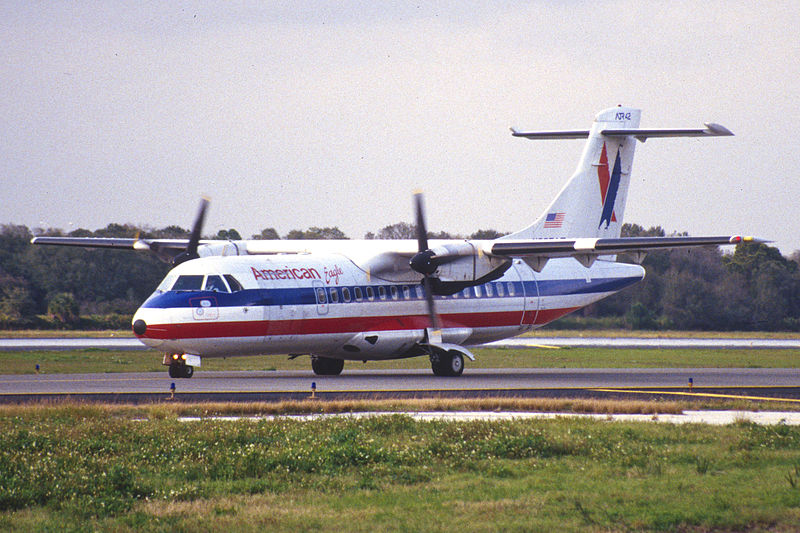
Just above, an image of the ATR-42 from American Eagle
/ American Airlines, which was one of the largest operators of the ATR-42 in
the world, serving regional destinations within the United States, many of them
with the French-Italian turboprop. Just below, another image of the ATR-42 from
the Brazilian regional airline MAP Linhas Aéreas, which serves the states of
the North Region of Brazil.


Just above, the ATR-42 from Pantanal Linhas Aéreas, a
company that no longer exists, was bought by TAM Linhas Aéreas, which, in turn,
became LATAM Airlines. This is the main vocation of the European-manufactured
turboprop: transporting passengers to locations far from large metropolises.
Just below, the two six-blade composite propellers of the ATR-42-600 provide
high performance and a lower noise level than in previous versions with
four-blade propellers.


Just above, the analog cockpit of the previous
ATR-42-300 version, with Collins avionics. It is not the most modern, but it is
complete for instrument flights. Just below, the digital cockpit of the more
modern ATR-42-600 version, which comes from the factory with a panel featuring
the EFIS - Electronic Flight Instrument System from the Thales brand, with the
EICAS - Engine Indication and Crew Alerting System and with the FMS - Flight
Management System.


Just above, the ATR-42 has good performance on short
runways, 1,500 meters long, on hot days. However, when it is not at its maximum
takeoff weight, it can operate on paved runways of only 1,200 meters in length.
On smaller runways, there are takeoff weight limitations. Just below, the
ATR-42 is also used in many other countries besides Brazil.


Just above, the landing gear is retractable and the
airplane cabin is pressurized, with the capacity to travel at altitudes of up
to 7,500 meters. Just below, the wide front left cargo door allows for the easy
introduction of air cargo pallets and containers in the cargo versions of the
ATR-42, such as, for example, the ATR-42-300 F version, exclusively dedicated
to cargo transport.


Just above, aircraft manufactured in the 1980s, 1990s,
and 2000s can be converted to exclusive cargo transport service, with the
permanent removal of passenger seats and the reinforcement of the passenger
cabin floor, among a few more modifications called retrofits within the
aeronautical field. Just below, another image of an ATR-42 converted for cargo
transport.

The blog Science, Technology and Art in Focus is
an english version of the portuguese blog Ciência
e Tecnologia em Foco, hosted on Google's
Blogger platform. This content was translated into english with the aid of AI – Artificial Intelligence, therefore
subject to translation errors. This blog is a mirror version of the original in
portuguese. If you prefer, access all the content of the original blog in
portuguese via the following link ( https://cienciatecnologiafoco.blogspot.com/
). Next, if you prefer, click on the visible menu in the upper-left corner of
the page, click the TRANSLATE /
TRADUCCIÓN button, and choose your preferred language.
Attention: The
information, concepts, and values (prices) issued in this article or page are
for informational purposes only and may not be absolutely precise and rigorous,
as that is not the goal of the blog. For more precise and rigorous information,
concepts, and values, contact the manufacturer and/or their sales
representative.
REFERENCES AND SUGGESTED READING
- Flight Safety Foundation: https://aviation-safety.net/wikibase/dblist.php?AcType=AT43
- Air Charter Service: https://www.aircharter.com.br/guia-de-aeronaves/fretamento-para-grupos/atr-france/atr42
- AeroIn (in portuguese): https://aeroin.net/atr-leva-mais-uma-encomenda-incluindo-o-novo-aviao-atr-42-600-stol/
- Exclusive Aircraft: https://exclusiveaircraft.co.uk/aircraft-sales/atr42-300f-sale
- Wikipedia: https://en.wikipedia.org/wiki/ATR_42
- Flight Safety Foundation:
- Flight Safety Foundation: https://aviation-safety.net/database/dblist.php?sorteer=casualties,datekey&kind=%&cat=%&page=1&field=typecode&var=010%
- Aerospace Technology: http://www.aerospace-technology.com/projects/atr_42/
- Flap Internacional (in
portuguese): http://www.revistaflap.com.br/web/aviacao-civil/noticias/5075-turboelice-atr-42-600-recebe-certificacao-da-easa
- Aviação Brasil (in
portuguese): https://aviacaobrasil.com.br/quanto-custa-cada-aeronave/
- Wikipédia (in portuguese): https://pt.wikipedia.org/wiki/ATR-42
- Aero Magazine / UOL: http://aeromagazine.uol.com.br/artigo/trip-realiza-primeiro-voo-exclusivo-de-carga_219.html
- Aero Magazine / UOL: http://aeromagazine.uol.com.br/artigo/atr-entrega-aeronave-numero-mil_467.html
- Air Finance Journal: http://www.airfinancejournal.com/Article/3160018/Aircraft-Profile-ATR-42-500.html
- Aerospace Technology: Image
- ATR (publicity): Images
- Wikimedia: Images


.jpg)
